
 EN
EN Return to Customer StoriesMINISO
MINISO's Global Breakthrough: How Meegle Supports Digital Operations for Over 7,800 Stores Worldwide

When you are browsing the latest seasonal products at a MINISO store in Los Angeles, store staff in Guangzhou have already completed the restocking and optimized merchandising of their best-selling items—this scenario plays out simultaneously every day across MINISO's more than 7,800 global stores.
As MINISO's global footprint continues to expand, the demand for omni-channel and end-to-end digitalization has increased exponentially. Yet, supporting this massive operation is an R&D team of just over 200 people.
In the midst of this rapid business growth, the backend R&D team faces real and concrete challenges: How can we efficiently support the quick iteration of multiple systems globally with limited resources? How can we maintain efficiency while ensuring orderly collaboration within the team?
In 2024, Vice President and Chief Technology Officer of MINISO Group, Issac Zhu, introduced the concept of "Digital R&D", marking the beginning of a deep collaboration between MINISO and Meegle.
The R&D Dilemma: How Can an Over 200-Person R&D Team Support the Digital Requirements of Global Stores?
"To support a business at the hundred-billion scale, how can we enhance R&D efficiency?" This question, posed by Issac Zhu, Vice President and Chief Technology Officer of MINISO Group, at an internal meeting, cut right to the core business challenge.
With the rapid expansion of global stores, the R&D team was constantly fighting on multiple fronts: the global launch of membership systems, the end-to-end integration of supply chain infrastructure, and the international rollout of store management systems. Requirements flooded in like a tide, posing significant challenges to team management.
A deeper challenge was the lack of "visibility" . Development progress relies on spreadsheets, with inconsistent processes across teams, making it difficult to obtain core production indicators and quickly identify issues.
The Solution: Meegle Connects the "Scattered Gears" and Standardizes Processes
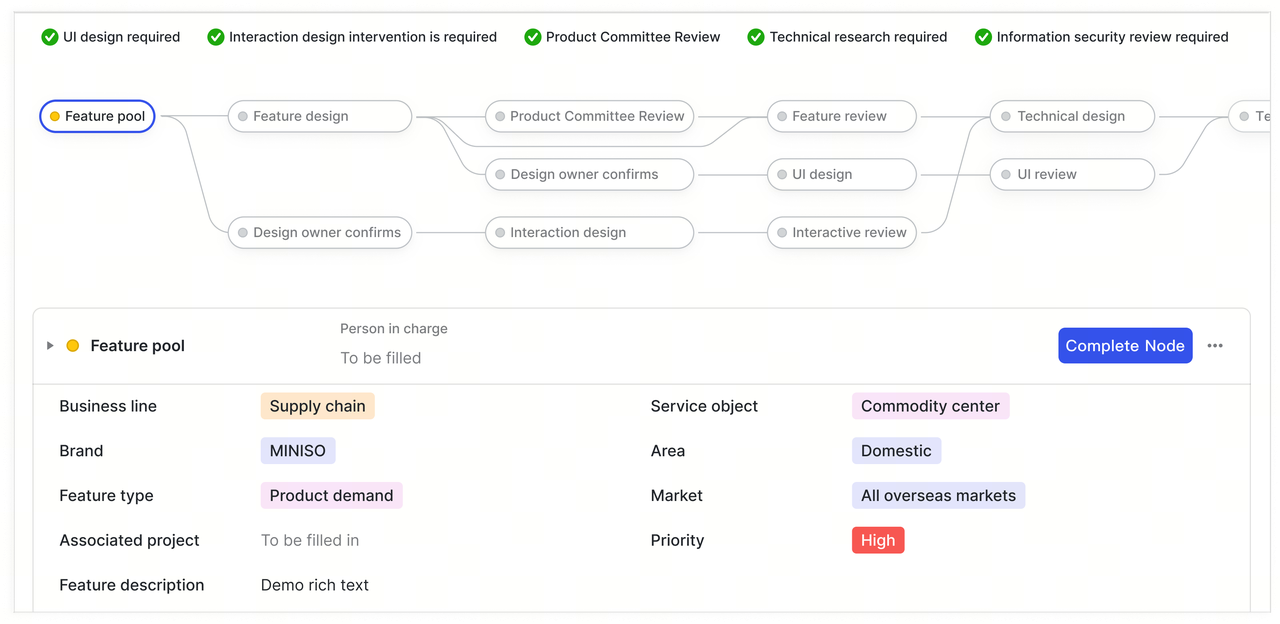
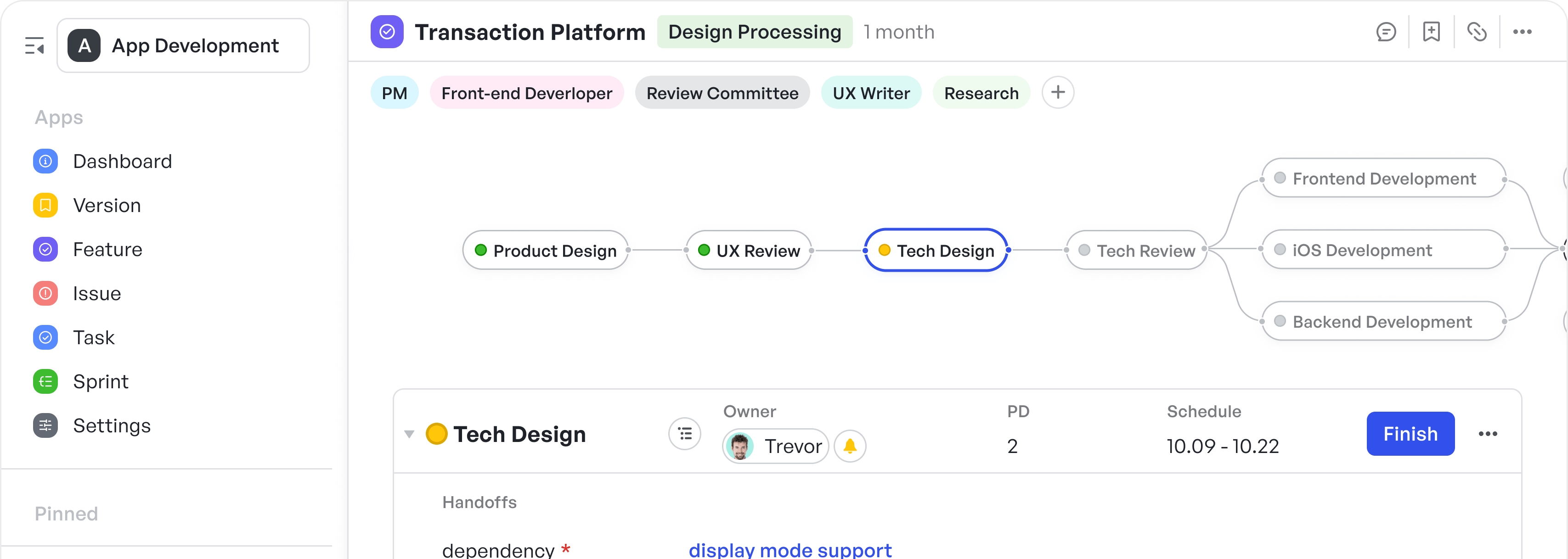
In early 2024, "R&D Digitalization" was set as the direction for transformation. Meegle's two core capabilities—visualized workflow and a highly configurable workflow engine—directly addressed the management pain points. Embedding management standards directly into their tools became the catalyst for the R&D team’s transition to high-precision operations.
Their first step was baking their collaboration standards right into the system. Everything from the format for feature submission, to the delivery milestones for each role, and the rules for cross-team handover, was hardwired through Meegle's workflow engine. To further complete the end-to-end workflow from testing to deployment, the team implemented a CI/CD integration solution, using Meegle's API and webhooks to synchronize information with the operations platform, thus automating the version deployment approval and setup.
Acting as a "silent collaborator", Meegle reduced the need for meetings and manual chasing, shifting the team from reactive chaos to proactive control.
This shift is most striking in high-priority projects. The traditional offline collaboration model often leads to delayed progress updates and information synchronization, making it hard to identify risks in a timely manner. The team now operates via standardized workflows on Meegle. Every milestone is transparent, and every deliverable, from product brief to testing and acceptance, is subject to rigorous, automated governance.
The results validated the change: in January 2025, the on-time delivery rate for all workflow nodes was about 87%; with the in-depth adoption of Meegle's collaboration model, this figure has steadily risen to 93.5%. This 6.5-percentage point jump represents the efficient collaboration of a dozen roles and marks a solid leap from the concept of R&D digitalization to its practical implementation.
Systematized Metrics: Reducing Cycles from 21 to 11 Days with Fully Visible R&D
Workflow standardization was just the starting point for R&D digitalization. For a global enterprise, a more pressing question arises: Are limited R&D resources laser-focused on the initiatives that truly move the needle amidst such rapid expansion?
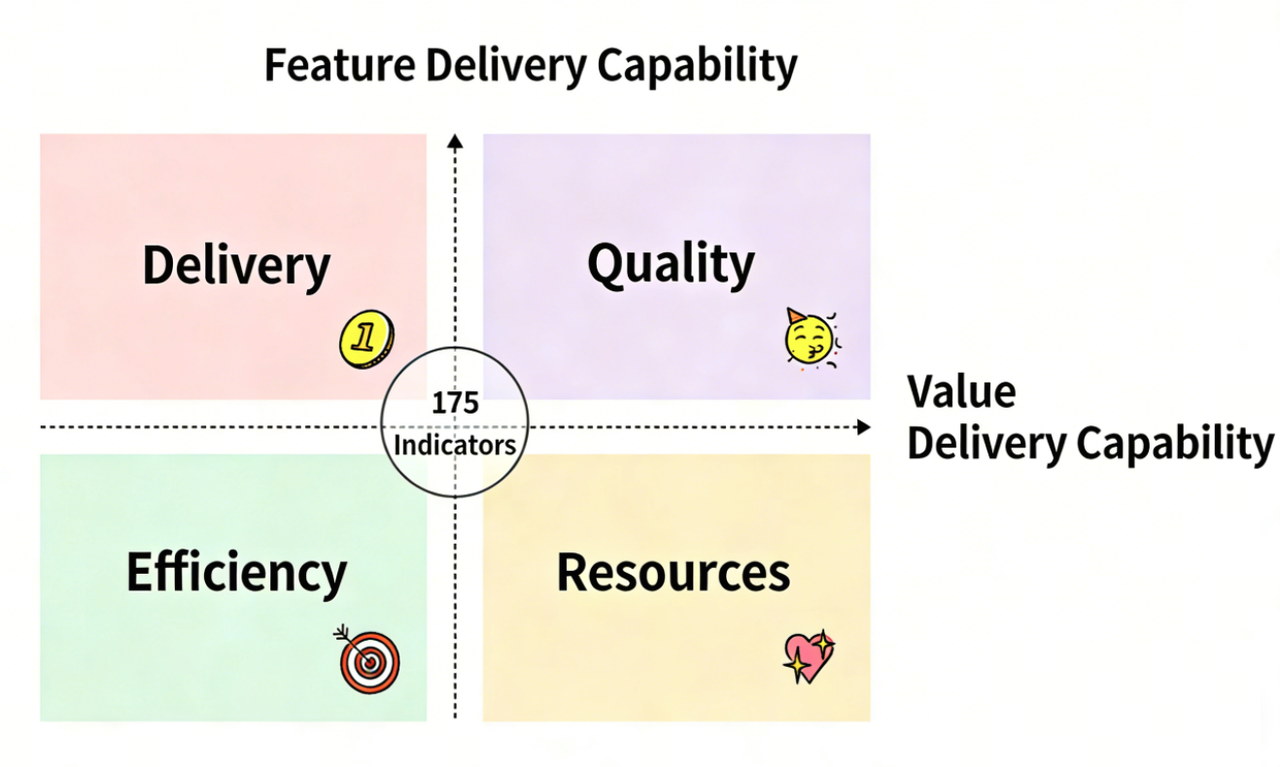
To tackle this challenge, MINISO's R&D team utilized Meegle's charts and analytics to develop a comprehensive metric mechanism that spans the entire product lifecycle. This mechanism centers on four crucial pillars: Delivery, Quality, Efficiency, and Resources.
By accessing Meegle's charts and analytics, stakeholders can quickly gauge overall performance and drill down into specifics—from the center to project teams and individual contributors. Performance indicators are clear at every level, allowing for strategic insights.
Management, leveraging Meegle's charts and analytics, saw the current flow of resources for the first time. Ou Yuan-Yinghua, PMO for MINISO Group's Digital Technology Center, explains, "We established dashboards based on four dimensions: workflow governance, standardization, delivery quality, and resource efficiency. This enables us to clearly assess if our central resource allocation is aligned with the Group's crucial 'must-win battles.'"
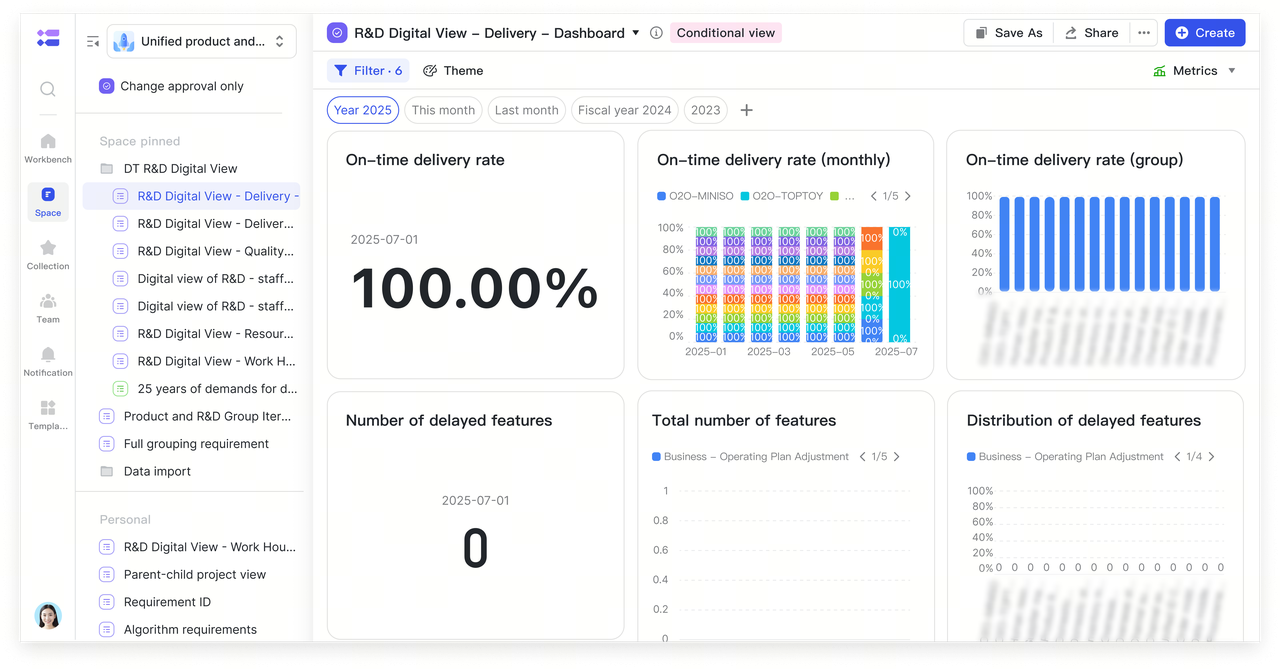
The power of this "visible" control really shines through in how easily the team can now access and trust their data. Prior to the adoption of Meegle in 2023, the team had to export scattered data from various sources and then spend significant time reconciling metrics and cleaning up information just to calculate key indicators like on-time delivery rate and feature full lifecycle duration. "The data we generated had delays and lacked objectivity, failing to accurately reflect the team's situation." Ou Yuan-Yinghua recalled.
The most striking benchmark is the feature delivery cycle: before implementing digital R&D, feature delivery averaged 21 days. Today, as visualized on the digital dashboard, that figure has been consistently compressed to just 11 days. This isn't due to the R&D team working longer hours but rather a result of standardized processes that clarify responsibilities and streamline collaboration—making everything more systematic and structured.
Smarter Decisions: Monitoring "Organizational Health" via Meegle-Powered Dashboard
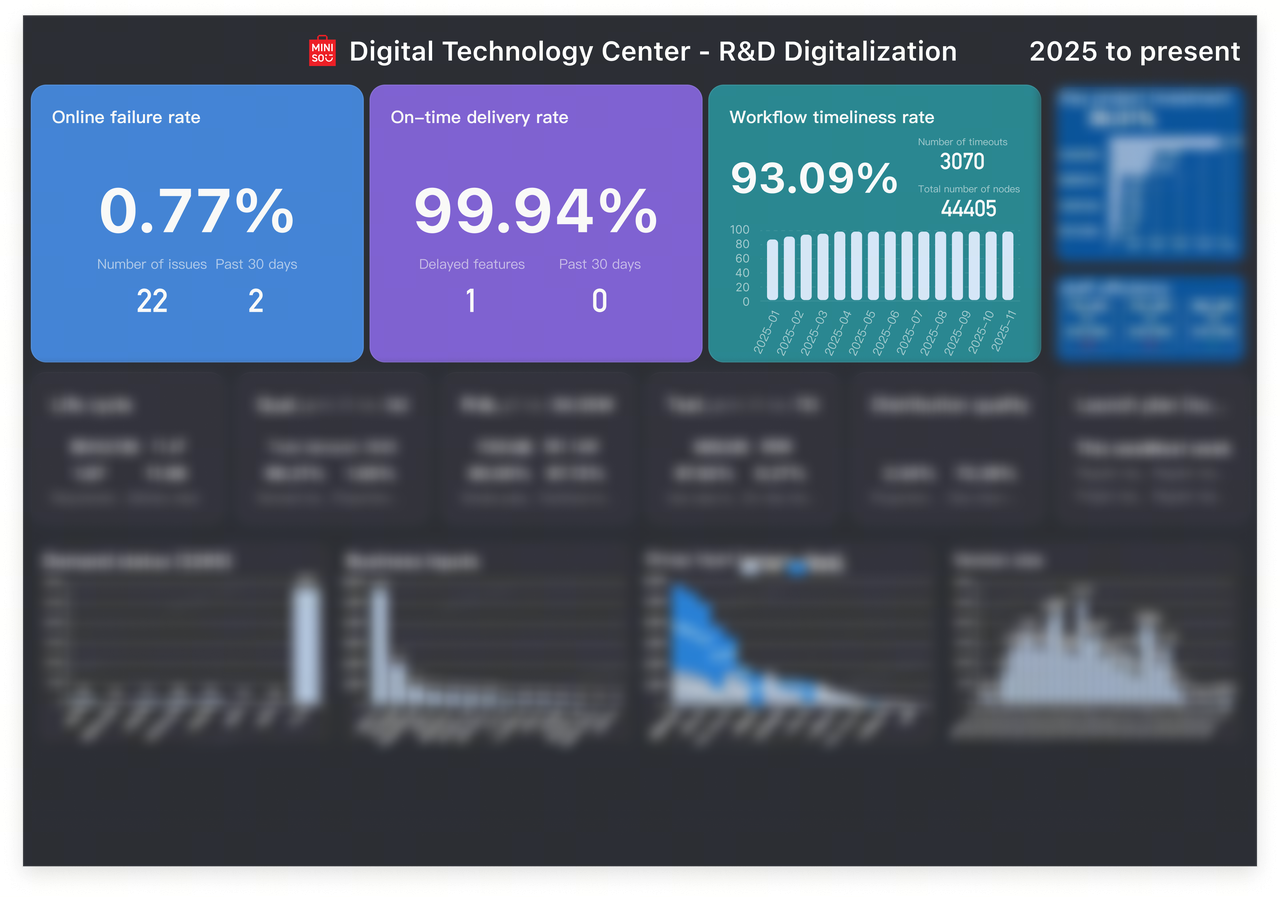
The metric mechanism built within Meegle has successfully laid a robust and measurable foundation for R&D performance management. Building on this, the upgraded "R&D Efficiency Dashboard" has evolved into an organizational decision-making cockpit. This transition from "collective data" to " visible insights" is key.
The dashboard's core intelligence comes directly from Meegle: the R&D team pulls foundational data from charts and analytics through API interfaces, aggregating and visualizing core indicators such as delivery, quality, workforce efficiency, and resources.
From macro to micro, management can simply tap the screen to dive into the charts and analytics on Meegle for specifics: the rationality of resource allocation, team delivery efficiency and quality, and the performance of feature throughput—providing a clear view of organizational health.
Issac Zhu summarized the results: "Leveraging Meegle's workflow engine, the entire R&D workflow has become highly transparent. We can track the on-time delivery and execution efficiency of every stage, and simultaneously grasp the improvement in full R&D lifecycle performance." The data bears this out: with a comparable team size to last year, feature delivery volume has doubled—achieving a remarkable leap in productivity.
For MINISO's ongoing global expansion, this dashboard has become the "intelligent command center" driving the lean development of the R&D system, always in sync with the rhythm of the Group's forward momentum.
R&D Digitalization: Making Global Expansion "Fast and Stable"
"How can digital capabilities support the operations of over 7,800 stores worldwide?" MINISO's answer was simple: the R&D team itself had to undergo digital transformation. This involved more than just introducing a tool; it was about using Meegle to achieve a management closed-loop, from "process standardization" to "intelligent decision-making".
As the CTO summarized, "Meegle is effective on two fronts: first, it excels at managing the entire feature workflow and CI/CD continuous integration; and second, we have built a complete R&D metric system on top of it, laying a solid foundation for R&D digitalization." This allows the R&D team, even with limited resources, to be agile in responding to front-end business needs (the "fast") while using data to ensure the stable implementation of long-term strategies (the "stable").
Now, global expansion is no longer supported solely by manpower, but by a transparent and robust digital R&D framework. It ensures that every digital requirement across the global enterprise is delivered smoothly within a controlled and highly efficient rhythm. This efficiency constitutes the core foundation of MINISO's confidence as it pursues steady, long-term success in the global market.
Stories you might also be interested in
Check All Customer Stories




Boosting Speed: Meegle Empowers LIZHI, a Leading Audio Platform, to Release Products 50% Faster
Learn More

Chi Forest: The Innovation Engine Behind the Hit Products and the Secret to Accelerating Growth
Learn MoreStart creating impactful work today


 English